Language as protocol — examples in the wild.
Written language has always been a protocol stack. A book-production factory just makes one layer — the stylesheet — visible and ownable. Here are real-world systems where language is already run as a strict protocol: controlled vocabularies, typed interfaces, conformance regimes, versioned specs. Field material for the workshop's lectures, demos, and the moment it clicks that this is everywhere.
★ The controlled vocabulary you already use — the styles dropdown
Every word processor ships a paragraph-styles menu — the little dropdown that says Normal text / Heading 1 / Title. It is the most-used controlled vocabulary on Earth, and almost nobody who uses it thinks of it as one. You already mark what a thing is and let the tool decide how it looks. The instructive part is how differently two everyday tools size that menu — because the gap between them contains the entire design theory.
the tiny palette ≈ six choices — Normal text, Title, Subtitle, Heading 1–3 (4–6 hidden). No character styles, no custom named styles — you can't invent an “Epigraph” or “Verse.” You can only redefine the six you're given. A deliberately small, closed vocabulary.
the massive palette Dozens of built-ins — Heading 1–9, Title, Subtitle, Emphasis/Strong, Quote/Intense Quote, Book Title, Caption, List Paragraph… — across five style types (paragraph, character, linked, table, list), with inheritance, a “style for the following paragraph” rule, and unlimited custom styles. A large, self-describing, evolvable vocabulary.
The leap from the Google Docs six to Word's hundreds is the whole controlled-vocabulary problem in miniature:
And the move is one participants have already made without a name for it: in Word, Modify style; in Docs, Update ‘Heading 1’ to match. Redefine the style once → every instance in the document re-renders. That is CSS Zen Garden — separation of layers — in a tool they already own.
Why it matters for a book factory specifically. Manuscripts arrive as .docx or Google Docs, so ingest and normalization is literally Job #1 in production. Whether the author used real styles or faked them with direct formatting is the difference between a clean import and a day of cleanup. “Select-all → Normal → re-tag semantically” is the real-world Strip step — in a tool everyone has open right now. This isn't an analogy for the work; it is the first hour of the work.
★ The curated middle — this studio's own font selector
The bar at the top of this site is a font picker: eight typefaces in two labeled groups — Mono/Sans (JetBrains, Martian, Plex, Geist) and Serif (Literata, Plex Serif, Source Serif, Newsreader) — plus a dark toggle. Pick one and the whole site re-renders in that voice. It is the curated answer to the sizing problem the styles dropdown poses — and it's the page on the projector.
data-font=“newsreader”
→
CSS resolves the real family / fallback / size-adjust
<html> element — which voice, not which font-family triple. The controlled-vocabulary move, exactly.
menlo→jetbrains) so old saved preferences still resolve. Deprecation with backward-compat, live — the semver / rulebook-archive idea in one small object.
Set the three side by side and the whole spectrum snaps into focus: Google Docs (too small — meaning leaks into formatting) → this picker (the curated middle) → MS Word (too large — expressive but nothing enforces it). And the demo needs no narration: click Literata and this page becomes a book. The tool teaching protocolization is itself protocolized — the most honest possible credential.
★ The canonical proof — CSS Zen Garden
Every design below is the exact same HTML file — not one character changed. Only the stylesheet swaps. That is separation of layers in its purest, most persuasive form: the semantic source is fixed and meaningful, and appearance is a swappable, downstream decision. It's the single flip that makes the whole thesis undeniable — and csszengarden.com is still online, unchanged in spirit for two decades.

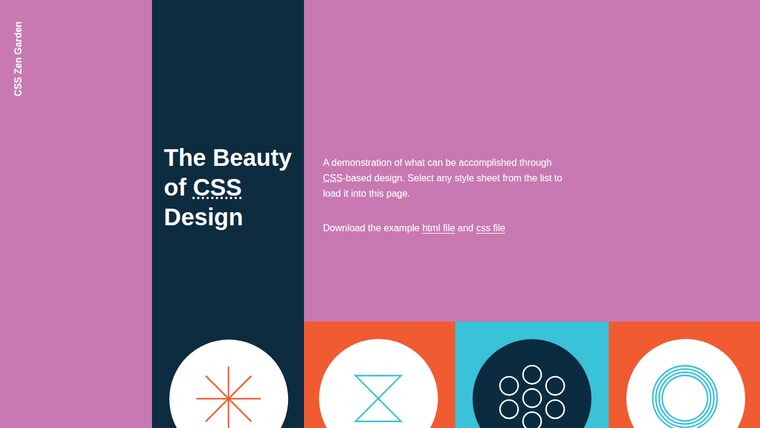
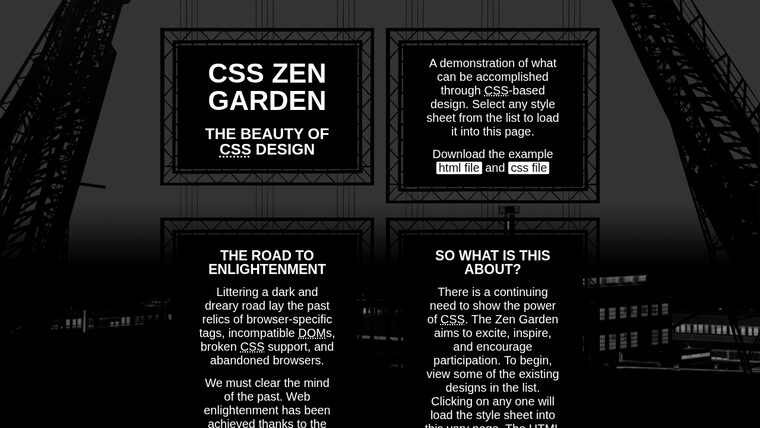
Same <h1>, same paragraphs, same list — three stylesheets.
This is the mechanism underneath everything else on this page. The styles dropdown, the studio's font picker, a book factory's stylesheet, an ABS rulebook — all of them work because “what a thing is” is stored once, and “how it looks” is resolved separately and swappably. Zen Garden just makes the swap visible in a single click. Browse the living gallery: csszengarden.com · the fixed source: HTML / CSS.
★ Conformance on hard mode — marine classification review
Marine classification societies (e.g. the American Bureau of Shipping) publish versioned engineering rulebooks — Rules for Building and Classing Marine Vessels, lifting-appliance requirements, and so on. When a shipyard submits engineering documents, surveyors return a findings log: a table of discrete, numbered conditions, each citing the exact rule clause the submission fails to satisfy. Every finding must be closed before the vessel is granted class.
That is exactly a stylesheet preflight — but in a domain where the stakes are lives and steel instead of curly quotes. A representative findings log looks like this:
| Finding | Type | Description | Status |
|---|---|---|---|
| EQUP-0008 | Technical | Rope line-pull analysis uses friction-loss constant K=1.045. Per the lifting-appliance rules that value is for bronze-bearing sheaves; for roller/ball bearings K shall not be less than 1.02. Please address. |
OPEN |
| EQUP-0009 | Technical | Submit hydraulic-piping detail: component cut sheets per 4-6-7/3; valve compliance/materials/pressure per 4-6-7/3.5.3; pipe schedule; hose & hose-end fitting IDs per 4-6-7/3.5.2. |
OPEN |
| EQUP-0011 | Technical | Redundancy calcs showing the A-frame sustains rated load on a single pair of hydraulic cylinders after loss of the second pair, per 2-9/9(ii); mode selection per 2-9/11; personnel recovery per 2-9/13; updated load charts. |
OPEN |
Illustrative rows, adapted from real classification-review practice.
Read that as a stylesheet and the isomorphism is total:
4-6-7/3.5.3
≡
a style name (Heading / Epigraph / Verse)
It is “hard mode” because the citations nest to absurd depth (2-9/9(ii)), the vocabulary is unforgiving, and non-conformance is not a style nit — the vessel doesn't sail. It makes the whole abstract argument visceral: this is what a controlled vocabulary looks like when it is load-bearing. And the rulebook archives — superseded editions kept on file, a submission judged against the edition in force at contract date — are versioned, inheritable protocols with backward compatibility, running live in industry.
Public sources (safe to cite & show):
Paris MoU Port State Control is the closest public marine twin — inspectors record coded, convention-cited deficiencies plus an explicit “action taken” status vocabulary (17 rectify before departure, 16 within 14 days, 30 detainable): our finding schema and our OPEN/closed vocabulary, in the open.
The rulebook side: ABS Rules & Guides archives.
01 The protocol concepts these make concrete
02 The starter shelf — other candidates
Grouped by the concept each best illustrates. Hardness: ⚙ light · ⚙⚙ real · ⚙⚙⚙ hard mode.
Conformance / linting regimes
- Paris MoU Port State Control⚙⚙⚙ — public marine twin of the classification findings log; coded, convention-cited deficiencies + an explicit “action taken” status vocabulary.
- FAA Airworthiness Directives⚙⚙⚙ — numbered, clause-cited, must-close findings against a versioned spec; new directives routinely supersede old ones. Fully public via the Federal Register.
- Building-code plan review⚙⚙ — a permit set bounced back with code citations; the most relatable version of the pattern.
- Journal desk-reject checklists⚙⚙ — formatting/citation conformance gating before peer review even starts. On-the-nose for writers.
- CI linters & pre-commit hooks⚙⚙ —
gofmt, ESLint,ruff: “the build won't merge until you conform.”
Controlled vocabularies
- Google Docs vs. MS Word styles⚙ — the most accessible controlled vocabulary in the world, and the one every participant already uses. The six-choice palette vs. the hundreds-deep one is the vocabulary-sizing problem. See the featured entry above.
- ICAO standard phraseology⚙⚙ — a spoken controlled vocabulary engineered so meaning survives noise (“Roger / Wilco / Say again”).
- ICD-10 / SNOMED medical coding⚙⚙⚙ — you can only say what the codebook lets you say, with care and billing consequences.
- MARC records + LCSH⚙⚙ — a book is a controlled-vocabulary record inside a library's protocol.
- Bluebook legal citation⚙⚙ — a rulebook whose whole job is making references machine-resolvable.
Separation of layers · versioning · machine authors
- CSS Zen Garden⚙⚙ — one HTML source, radically different renders, controlled entirely by the stylesheet. The whole thesis in one flip.
- JATS / DocBook / DITA⚙⚙ — publishing-native proof that “structure, not presentation” is already industrial practice.
- Semantic Versioning⚙⚙ — the crisp statement of backward-compatibility-as-contract.
- JSON-schema-constrained generation⚙⚙ — an LLM forced to emit conformant output: the machine-side mirror of preflight, with no special path. (structured outputs)
Part of the Protocolize Your Book workshop — a working book-production factory reframed as a protocol stack. Written language has always been protocolized; a stylesheet is just the layer writers can see and own.